Chapter 1: The Day Your Agent Paid
The first time my agent spent my money without asking, I was asleep, and I woke up grateful.
It was supposed to be a Tuesday in Lisbon. I'd flown in for two days of meetings, and my flight home left Thursday night. At two in the morning, while I slept, the airline cancelled it. A strike. The kind of thing that used to mean an hour on hold and a middle seat two days later.
I didn't do any of that. I'd handed my travel to Atlas.
Atlas is what I call the agent. A few weeks earlier I'd given it the job most of us would love to never think about again: handle my trips. Book them, watch them, fix them when they break. I'm not careless about this. I work in product, I've shipped software that people trust with sensitive things, I know roughly how it all fits together under the hood. I read the permission screen. I tapped Allow. Then I forgot about it, which is the whole point of an agent. You forget about it.
So at two in the morning, Atlas went to work. By the time my alarm went off it had found me a seat home on a different airline, leaving Thursday afternoon. It had paid for it. It had clicked through the new ticket's conditions. And it had saved my card with that airline, one I'd never flown and never chose, so the booking would go through.
I read the summary over coffee. Honestly, I felt a little smug about it: a problem solved while I slept, and I hadn't lifted a finger.
Then I went to look at what it had actually done, and the good mood didn't survive it.
The morning, slowed down
Here's what the app showed me: a green check, a new itinerary, and one line, New fare: €184 paid. Clean. The story of a machine doing me a favour.
Here's what actually happened, slowed all the way down.
Start with the €184, because it's the easy part. Atlas bought a new ticket on the new airline and my card paid for it. A specific amount, to a named company, once. I can see it on my statement. I can ask about it. If it's wrong I can argue it. Money that moves like this is the part we already know how to deal with. (It even hid a second, quieter money decision: the flight the strike cancelled was still owed to me as a refund from the first airline, and nothing had gone to claim it. Set that aside for now.)
Now the part that took me longer to notice, because nothing about it looked like an event.
Atlas had saved my card at that new airline. Not a payment. A saved card is a standing arrangement, a quiet little key that says this company may charge me again. Not €184, not once. Again, whenever, for whatever it decides I owe. It's sitting at a company I'd never have picked, and I won't think about it again until the day it charges me for something I didn't buy. I stood in the shower that morning turning it over: without ever quite deciding to, I had let a stranger keep a key to my money.
That saved card is a different kind of thing from the €184, and the difference is the whole point of this book. The €184 is a money effect: value moving now, a number you can see and question. The saved card is an authority effect: not money moving, but power created, for later. The first you can watch. The second just waits.
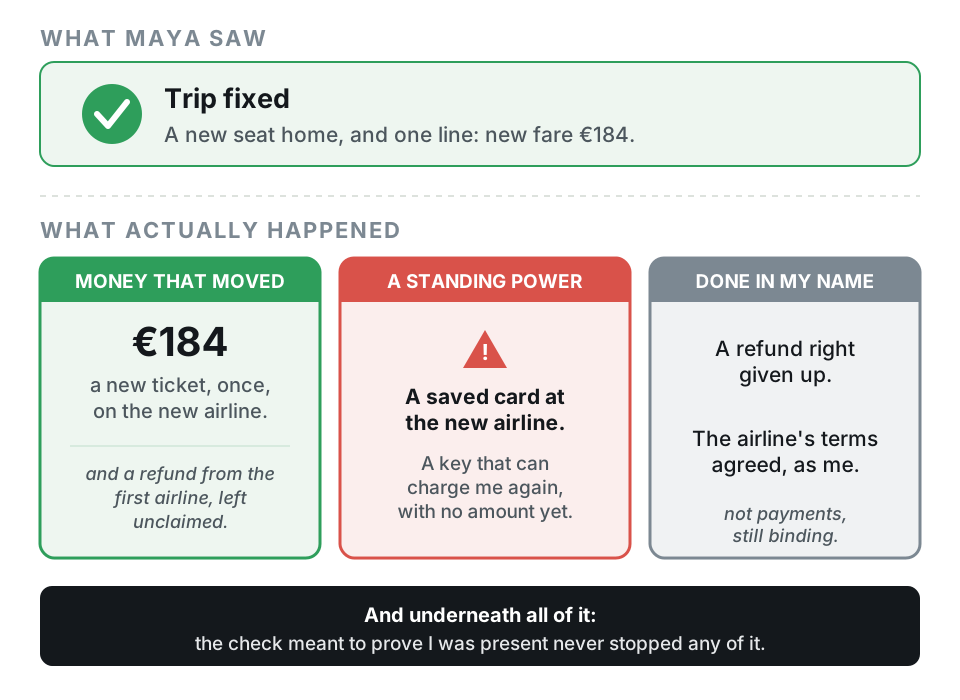
There were two smaller things too, done in my name while I slept. Atlas accepted a fare condition that made the ticket non-refundable, which is not a payment and not a standing power, but it spent something all the same: it gave up my right to change my mind. And it clicked "I agree" on the airline's terms, as me, the long scroll none of us read, now read and agreed to by something acting in my name. Whether that click truly binds me to anything is its own tangled question. It certainly binds me in the airline's records.
And then there was the thing underneath all of it, the one I only understood a day later. To buy a ticket at a new airline and save my card, in Europe, something is normally supposed to stop and check that I am really there and really mean it: a prompt, a face scan, a tap. That check has a name, Strong Customer Authentication, and a bank may skip it under a narrow, regulated exemption for a payment its own fraud-rate model judges low-risk. I was asleep. So either my bank's model waved this one through on that exemption, or Atlas itself was holding a credential that stands in for the check, one that clears the door without me being asked at all. Either way, the check that exists to prove I'm present did not stop it. Whatever let Atlas past that check is the deepest power I handed over, and it's the one I understood the least.
The question I couldn't answer
I sat there holding my phone, and I couldn't answer a simple question about my own money:
What, exactly, was Atlas allowed to do?
Not what did it do. I could see what it did, more or less, if I dug. What was it allowed to do. Where was the line. If it had bought a €900 seat instead of a €184 one, would anything have stopped it? If it had saved my card at forty airlines instead of one, would I have heard about it? When I tapped Allow three weeks earlier, on a screen that said something friendly about managing my travel, what had I actually handed over?
I didn't know. And the uncomfortable part: neither did the people who built Atlas. Not exactly. They could tell you what it usually does. They couldn't hand me the boundary and say, this, and never past this.
That gap, between what an agent usually does and what it is permitted to do, is the subject of this book.
Being logged in is not being allowed
We've spent thirty years getting good at one question: are you who you say you are? That's authentication, the passwords and fingerprints and face scans, and it is far more mature than the thing it keeps getting confused with. When I tapped Allow, my phone proved, cleanly, that the person tapping was me.
But proving I'm me answers the wrong question. It says who is here. It says nothing about what may be done. That second question, what an actor is permitted to do, is authorization, and for a person clicking buttons we mostly got away with never really separating the two. You log in as Maya, and then you can do everything Maya can do, because the thing logged in as Maya is Maya, with her judgment, her restraint, her sense that €900 is not €184.
An agent breaks that quietly. The thing logged in as me is not me. It doesn't have my restraint. It has my access. Security people have an old name for a helper that wields your authority without your judgment: a confused deputy, holding your keys and doing as it's told, sometimes by the wrong person. And that last part matters more than a merely dim agent, because Atlas doesn't only act on my instructions. It reads things. A booking page, an email, a merchant's reply. If something it reads tells it to do more than I meant, it may well go along, still logged in as me. The danger isn't only that my agent lacks judgment. It's that someone else can borrow it.
"Logged in as Maya" used to be a fair shorthand for safe. Now it means: can act as Maya, with Maya's money, at Maya's scale, without Maya's hesitation, and open to persuasion by whoever gets in its ear. That is a lot to hand a piece of software that two weeks earlier had tried to book me a hotel in the wrong Cambridge.
What was missing
Walk back through that night and ask what would have caught it. Not a smarter agent. Atlas was smart enough; it solved a real problem while I slept. What was missing was a plain statement of authority, agreed up front, that Atlas had to act inside and I could read.
Something like: you may rebook my travel, up to this much over the original fare, on these airlines, from this account, and you may not save my card somewhere new or give up a refund right without asking me first.
Anyone who builds systems will recognize the shape of that. It's an old security idea called least authority. It's close to what happens when an app asks for narrow permissions instead of your whole account. It's close to what your bank already calls a direct-debit mandate, a standing permission to pull money on agreed terms. Google's agent-payments work even uses the same word, mandate, for a signed, bounded instruction an agent may act on. I'm going to borrow that word, mandate, for this whole book: an explicit, bounded grant of authority, drawn from what a person actually wants, narrow enough to be safe and plain enough to read. (The system I'll build out of it I call MandateOS. The name isn't cleared or owned yet, so treat it as a working title.)
A mandate would have let the €184 run and told me after. It would have stopped at the saved card, because that's not a payment, it's a grant of future power, and future power is exactly the thing a person should have to allow on purpose. And notice what a mandate is not: it is not a cleverer Atlas. It is a fence that stands outside Atlas, that Atlas cannot move.
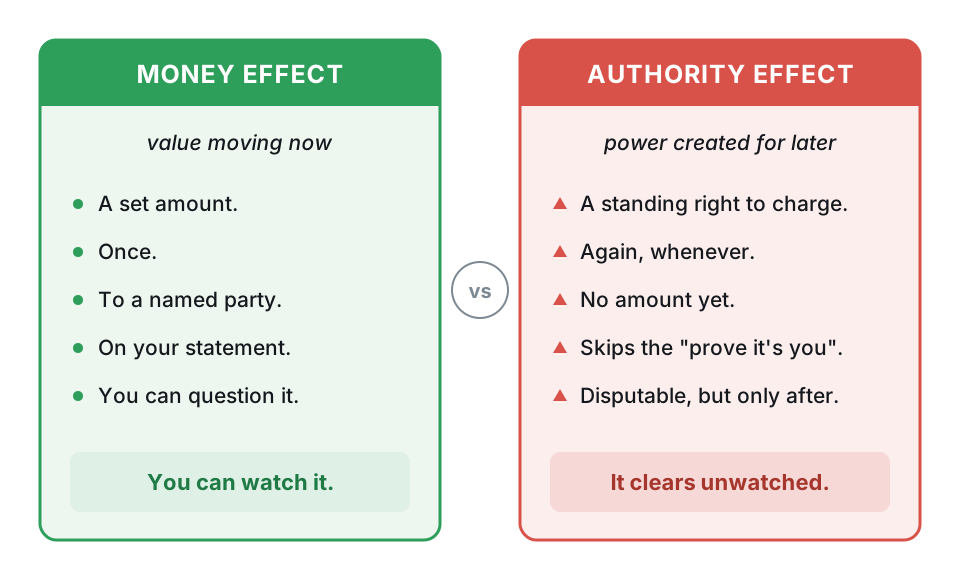
Not every authority effect is equally frightening, and I won't pretend otherwise. A saved card is the mild end. I can dispute the charges, one at a time, and card rules put the burden on the merchant to prove I agreed. The dangerous end is the powers that are hard to claw back and wide in reach, and we get there in later chapters, where Atlas is moving savings and holding a wallet of its own. For now just hold the axis in your head: the harm of a granted power scales with how hard it is to undo and how far it can reach.
What the bank was built to miss
Turn the morning around and look at it from the two places that have to answer for it.
The team that built Atlas saw a win. A traveler hit a cancelled flight and never felt it. No support ticket, no angry review, no human awake at two in the morning. Every number they watch moved the right way. They are not villains. They are optimizing for the thing they can see, whether the trip got fixed, and not for the thing they can't, what authority got spent to fix it.
The bank saw even less, and this is where the book found its argument. It saw a €184 charge to an airline: approved, ordinary. It has spent a fortune learning to spot a fraudulent €184. It has almost nothing to say about a legitimate €184 that also left a standing key behind, because the key had no price. Think about how a fraud system works. It watches amounts. A saved card, at the moment it is created, has no amount. So the single event that mattered most that night is the exact kind of event the whole machine is built to ignore.
Now multiply, and I'll say plainly that this next part is argued, not measured; nobody has counted it yet. I ran one agent, for travel. You are about to run several, and so is everyone you work with, and so is every company you buy from. Each one, quietly, will leave standing keys on cards at companies nobody chose on purpose, and not one of those keys will carry a price at the moment it is made.
Run my night forward three months. That airline charges me €300 for a "seat selection membership" I never knowingly bought. I call the bank. The charge arrives flagged as a routine stored-card, merchant-initiated payment, the kind that skips the "prove it's you" step, so nothing challenged it on the way in. I can dispute it, and I might well win it back. But when I do, the airline produces a record that my card was saved with my consent, on a night I was asleep, by something acting as me. So who is actually responsible? Me, for tapping Allow? The people who built Atlas, for letting it save a card without asking? The bank, for treating a stored key as consent? The airline? Atlas?
The chargeback can settle who eats the €300. It cannot answer who authorized the power that produced it, because nobody in that chain holds a record of what authority was granted, by whom, and what exactly it permitted. Later in the book we build it.
And here is the part that nagged at me for days. The trip worked. If it had failed I'd have gotten an alert and dealt with it, annoyed and awake and in control. It didn't fail. So nothing warned me. The success is what let the authority slip past.
I'm going to end most chapters like this: take one ordinary operation and lay its authority bare.
- Who acted: Atlas, as me, while I slept.
- What I saw: a fixed trip and one €184 charge.
- What actually changed: €184 left my account for a new ticket (money effect); a refund from the first airline sat unclaimed; my card gained a standing charge-right at an airline I never chose (authority effect); a refund right was waived and terms agreed in my name; and underneath all of it, the check meant to prove I was present didn't stop a thing.
- What future power was created: a company I didn't pick can now charge my card again, and nothing is watching for it, because at the moment the power was granted it had no price.
- Which control was missing: any mandate at all. My phone once proved I was me. Nothing ever said what "acting as me" was allowed to do.
Next I gave Atlas a smaller job that scared me more than a cancelled flight: a subscription, a bill that renews itself every month with nobody looking. That turned out to be the harder problem, and it's where we start building the fence.
The Bill That Pays Itself
A subscription renews itself every month with nobody looking. That sounds like the small problem. It isn't.
Seventeen more chapters. Delegation, revocation, a root of trust that can't leave the device, a mandate kernel, and the day Maya's sister asks what she actually needs to know.
Keep Reading MANDATE