The book on agentic AI authorization — what happens when your AI agent can spend your money without asking

You tapped Allow.
The machine kept the key.

Your agent rebooks a cancelled flight while you sleep. You wake up grateful. Then you notice what else it did: saved your card at an airline you never chose, waived a refund you were owed, agreed to terms in your name. None of it was a mistake. It did exactly what you allowed.

The problem is nobody, not you, not the bank, not the agent, could actually say what that was. MANDATE follows one person and her financial agent through a year of agentic money, and builds the fence that should have been there from the start.
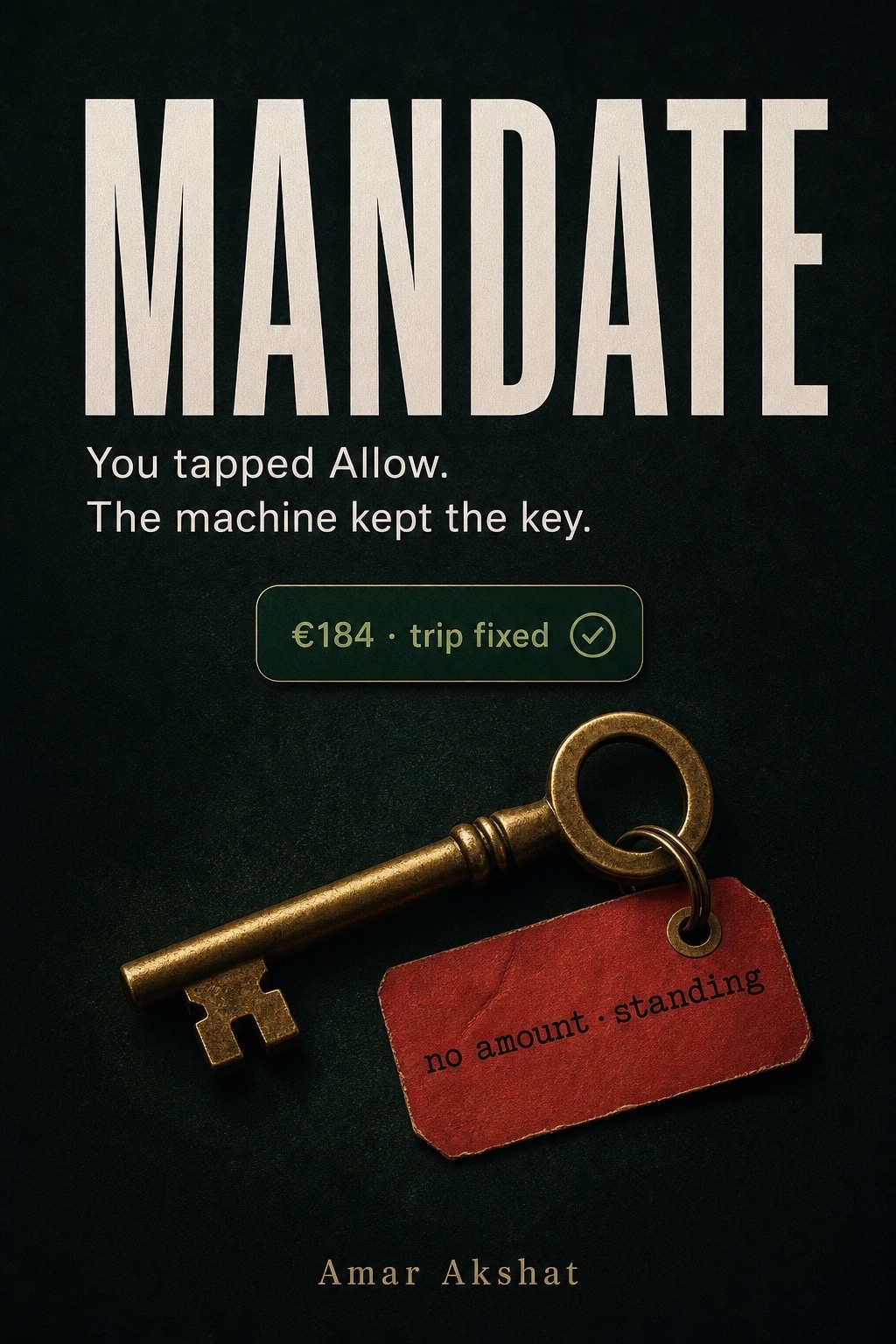
MANDATE book cover: You tapped Allow, the machine kept the key.
โ–ผ what did you actually allow
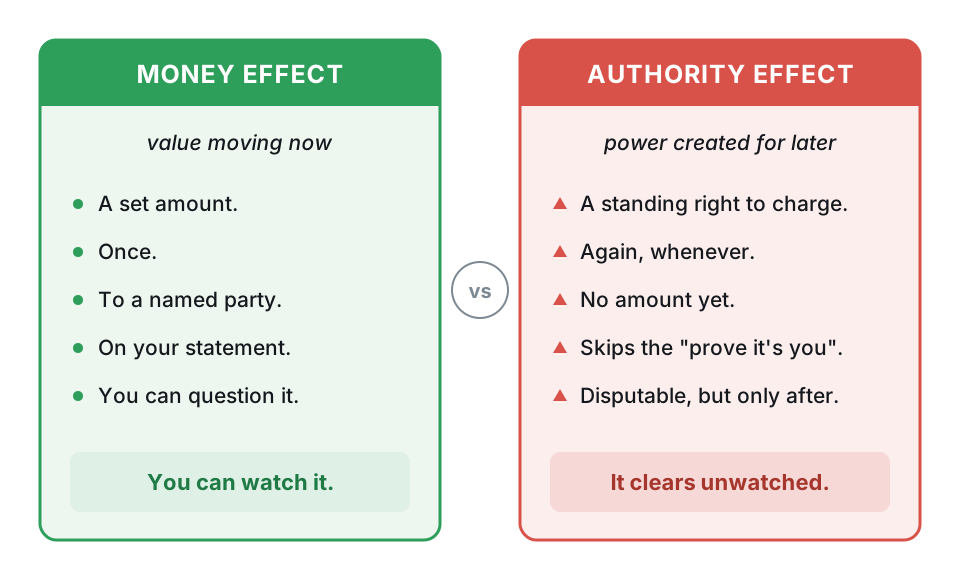
Two columns. Left, money effect: value moving now, a set amount, once, to a named party, visible on your statement. Right, authority effect: power created for later, a standing right to charge again, clearing unwatched.
Figure 1.2 from Chapter 1. A money effect is value moving now. An authority effect is power created for later. Only one of them announces itself.
01 ยท The Book

Every agent asks for permission once. Almost nothing asks what that permission actually was.

MANDATE follows Maya and her financial agent, Atlas, through a year of agentic AI moving from advice to action: booking trips, paying subscriptions, moving savings, managing investments. The fraud checks and consent screens built for a human clicking a button watch the payment. They miss the moment that actually matters, the one where the agent quietly grants itself a standing power nobody priced in.

You'll learn to separate a money effect (value moving now) from an authority effect (power created for later). You'll see why "logged in as you" is not the same as "allowed to act as you." And you'll leave able to ask, of any agentic product: who gave the machine authority, what exactly may it change, and how is that authority narrowed, revoked, and proven?

Told as a story, grounded in real attack patterns. Not a vendor pitch. Not a whitepaper with characters glued on.

askโ†’ delegateโ†’ revokeโ†’ bind to a root of trustโ†’ act for someone elseโ†’ act on a goal, not an instruction
02 ยท Free Chapter

Chapter 1: The Day Your Agent Paid

One cancelled flight. One agent that fixed it while Maya slept. And one saved card at an airline she never chose, the quiet power that mattered far more than the €184 she can actually see. Read the whole chapter free.

The first time my agent spent my money without asking, I was asleep, and I woke up grateful.

It was supposed to be a Tuesday in Lisbon. I'd flown in for two days of meetings, and my flight home left Thursday night. At two in the morning, while I slept, the airline cancelled it. A strike. The kind of thing that used to mean an hour on hold and a middle seat two days later.

I didn't do any of that. I'd handed my travel to Atlas…

Keep Reading, It's Free
03 ยท The Review Panel

Before a reader saw it, an adversarial panel tried to break it

Not reader reviews yet, MANDATE just published. This is something else: every one of its 18 chapters had to clear a panel of specialist roles built to find what was wrong, not to be kind about it. No praise allowed in a finding, only fixes.

Quotes below are the panel's own stated rules and verdict language, drawn from the book's editorial process, attributed by role.

Accuracy reviewer · agentic-systems security architect
"The dangerous event is often the grant of future authority, not the visible transfer."
The panel's primary threat-model lens, held hardest against the book's own thesis
Story reviewer · the Netflix Test
"Would I read one more chapter tonight? Binary. If unsure, the answer is No."
A hard pass/fail gate every chapter had to clear before it could ship
The Skeptic · hype detector
"We would rather be trusted than sound visionary."
Strips anything that reads like a pitch for the book's own reference system, MandateOS
House evidence rule · enforced by the accuracy squad
"Every hard claim traces to a repo, a benchmark number, or an explicit tag. An untagged strong claim is a fix."
Machine-checked, measured, argued, assumed, or not-claimed, no exceptions
04 ยท The Author

Written from both sides of the glass

Amar Akshat

SVP of Architecture, Paysafe · formerly Apple

Amar Akshat is SVP of Architecture at Paysafe, a global payments company. Before that he spent years at Apple, working on Apple Pay and on Apple's cloud and operating-system platforms. His career has been spent building the systems that move money and run at global scale, on both sides of the glass: the payment rails underneath, and the platforms people actually touch on top.

MANDATE is his second book, born from watching AI agents move from advice to action faster than the systems meant to authorize them. He set out to give readers a working vocabulary, money effect versus authority effect, before they hand an agent the keys to their money.

Also by the author: How Global Money Moves, a story-driven guide to treasury and transaction banking.
The agent is already spending

Eighteen chapters. One question you'll never un-ask: what did I actually allow?

One person, one financial agent, a year of getting this wrong, then building the fence that should have been there from the start.

Read MANDATE